The greater than and less than signs can be surprisingly confusing for young learners. A child may know that 8 is bigger than 5 but still write the comparison symbol the wrong way around.
The good news is that this usually does not mean the child does not understand numbers. In many cases, the difficulty comes from remembering which way the symbols > and < face.
A simple teaching sequence can help: compare the numbers first, say the relationship aloud, and choose the symbol last. Then a visual memory trick, such as a hungry number monster that always opens its mouth toward the larger number, can help students remember the direction of the sign.
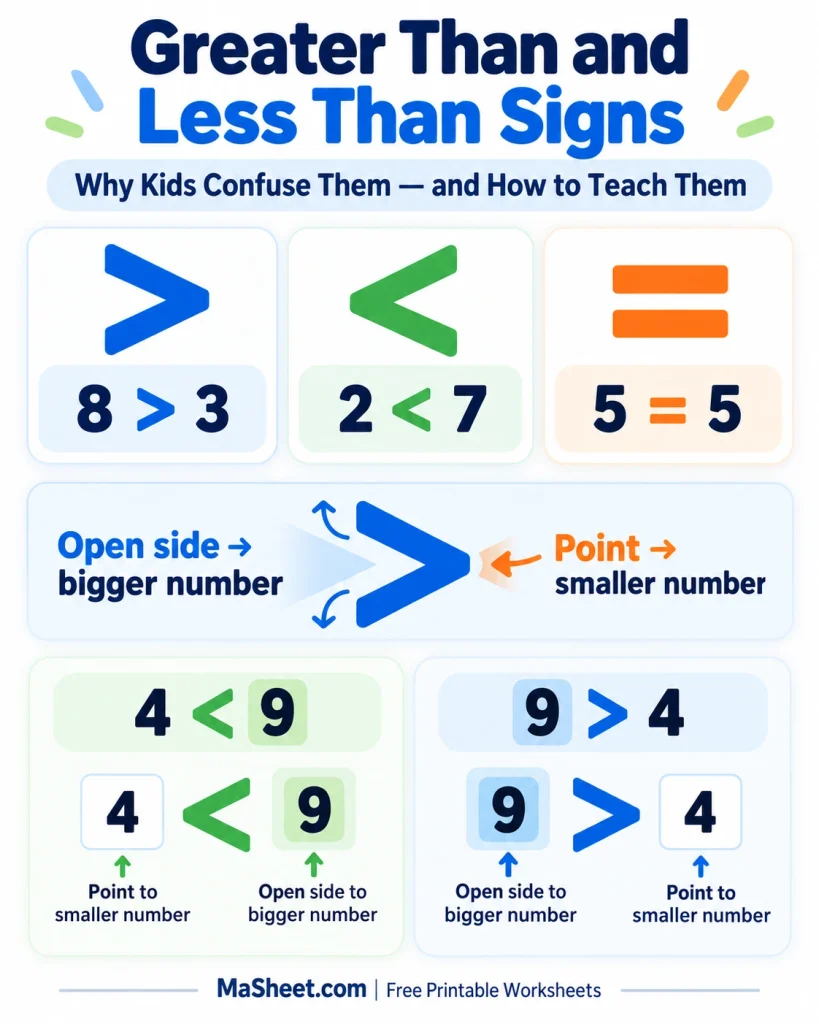
Quick Answer: The greater than sign (>) shows that the value on the left is larger than the value on the right. The less than sign (<) shows that the value on the left is smaller. The open side faces the bigger number, while the point faces the smaller number.
In This Guide
- What the greater than and less than signs mean
- Which sign means greater than and which means less than
- Why children confuse the signs
- How to teach the signs step by step
- The hungry number monster trick
- Where to start practicing
- Common mistakes to watch for
- Frequently asked questions
What Are the Greater Than and Less Than Signs?
The greater than and less than signs show the relationship between two values.
| Symbol | Meaning | Example |
|---|---|---|
| > | Greater than | 8 > 3 |
| < | Less than | 2 < 7 |
| = | Equal to | 5 = 5 |
For example, 8 > 3 means “8 is greater than 3.” On the other hand, 2 < 7 means “2 is less than 7.”
When both numbers have the same value, students use the equal sign. For example, 6 = 6.
Older students may also encounter ≥ and ≤, which mean “greater than or equal to” and “less than or equal to.” These are different from the basic > and < signs taught in this guide.
Which Sign Means Greater Than and Which Means Less Than?
The easiest way to read the symbols is to look at the open side and the pointed side.
- The open side faces the larger number.
- The pointed side points toward the smaller number.
So in:
9 > 4
the open side faces 9 because 9 is the larger number.
In:
3 < 8
the open side faces 8, while the pointed end faces 3.
Why Do Children Confuse Greater Than and Less Than Signs?
Many children understand which number is larger but still reverse the comparison symbol. Several different difficulties can cause this.
1. The Signs Look Like Mirror Images
The symbols > and < are visually very similar. One points left and the other points right, so young learners can easily reverse them.
2. Students Try to Remember the Symbol Before Comparing the Numbers
A common mistake is asking, “Which way does the sign go?” before deciding which value is larger.
This makes the task harder than necessary. Students should first answer a simpler question:
Which number is bigger?
Only after that should they choose the symbol.
3. A Memory Trick Has Replaced Understanding
Visual tricks can be useful, but they should support number sense rather than replace it.
If a child only remembers that an animal or character “eats the bigger number,” the child may still struggle when the numbers become larger or when place value is involved.
4. The Child Is Still Developing Number Sense
Sometimes the symbol is not the real problem. A student may still be unsure whether 7 is greater than 5 or whether 42 is greater than 39.
In that case, more practice comparing quantities and number values should come before intensive symbol practice.
A Better Way to Teach Greater Than and Less Than Signs
Instead of starting with the symbol, teach the comparison in four simple steps: Compare → Say → Choose → Check.
Step 1: Compare the Numbers
Show the student:
7 ___ 4
Ask:
Which number is greater?
The student should identify 7 as the greater number before thinking about the sign.
Step 2: Say the Relationship Aloud
Ask the student to say:
Seven is greater than four.
This connects the mathematical language to the values.
Step 3: Choose the Symbol
Only now should the student write:
7 > 4
This sequence reduces guessing because the student already knows what the symbol needs to represent.
Step 4: Check the Direction
Before moving on, ask the student to check the symbol: does the open side face the bigger number, and does the pointed end face the smaller number?
The Hungry Number Monster Trick
Once students understand which number is greater, a visual memory trick can help them remember which direction the sign should face.
Imagine the comparison symbol as a hungry number monster.
- The monster always opens its mouth toward the bigger number.
- The pointed end turns toward the smaller number.
For example:
4 < 9
The monster opens its mouth toward 9 because 9 is larger.
Now reverse the numbers:
9 > 4
The mouth still faces 9. The symbol changes direction because the larger number has moved to the other side.
Do Not Teach the Monster Trick Alone
The hungry monster is useful as a memory aid, but it should not become the entire lesson.
A student should be able to explain:
- which number is greater,
- which number is less,
- why the relationship is true, and
- what the symbol means.
The same four-part routine can be used each time:
Compare → Say → Choose → Check
First compare the values. Next, say the relationship aloud. Then choose the symbol. Finally, use the hungry monster as a quick visual check.
Start With Small Numbers
Children usually learn comparison more successfully when they begin with small, familiar values.
For focused practice with one-digit values, use our Comparing 1-Digit Numbers Worksheets. Every problem compares one one-digit number with another, so students can focus on the meaning of the symbols without also managing more complex place value.
Students who are ready for a slightly wider range can continue with the Comparing Numbers to 20 Worksheets.
Then Move to Two-Digit Numbers
Once students can compare small numbers confidently, the next challenge is place value.
For example, when comparing 47 and 52, students should compare the tens first. Because 5 tens are greater than 4 tens, 52 is greater than 47.
Focused Comparing 2-Digit Numbers Worksheets can help students practice this step without mixing numbers of different lengths.
Common Mistakes to Watch For
- Choosing the sign first: Ask students to compare the numbers before thinking about the symbol.
- Looking only at one digit: With multi-digit numbers, students should compare place values from left to right.
- Forgetting the equal sign: Include examples where both values are the same.
- Relying only on a mnemonic: Make sure students can explain the relationship in words.
- Moving to large numbers too quickly: Build confidence with smaller numbers first.
How Parents and Teachers Can Practice Without Worksheets
Comparison practice does not always need to happen on paper.
- Show two number cards and ask which number is greater.
- Use small groups of counters and compare the quantities.
- Place two numbers on a number line.
- Ask the child to create a true comparison using two numbers.
- Say a comparison sentence aloud and ask the child to write the symbol.
These activities help connect the symbol to the underlying number relationship.
How to Know When a Child Understands the Signs
A student is developing a strong understanding when they can do more than simply place the correct symbol.
They should be able to explain statements such as:
- 8 is greater than 5, so 8 > 5.
- 3 is less than 7, so 3 < 7.
- 6 and 6 have equal value, so 6 = 6.
If the student can explain why the comparison is true, the symbol is becoming connected to real mathematical understanding rather than simple memorization.
Frequently Asked Questions
Which Way Does the Less Than Sign Face?
The pointed end of the less than sign faces the smaller number, while the open side faces the larger number. For example, in 3 < 8, the point faces 3 and the open side faces 8.
What Is the Easiest Way to Remember Greater Than and Less Than Signs?
Compare the numbers first. Then remember that the open side of the symbol faces the bigger number and the point faces the smaller number. A visual memory aid such as the hungry number monster can be used as a final check, not as a replacement for understanding the values.
Why Does My Child Keep Reversing > and <?
Many children know which number is larger but still reverse the symbols because > and < look like mirror images. Have the child compare the numbers and say the relationship aloud before choosing the sign.
When Should Children Learn Greater Than and Less Than Signs?
Introduce the symbols after children can reliably compare small quantities and written numbers. Understanding which value is greater, less, or equal should come before memorizing the direction of the symbol.
Practice Greater Than and Less Than With Printable Worksheets
After students understand the meaning of the signs, repeated practice can help them use the symbols more confidently and accurately.
MaSheet provides printable comparison resources organized in two ways: by number range and by number of digits.
Browse the complete Comparing Numbers Worksheets library to choose the level that best matches the learner’s current skills.
You can also explore more free printable math worksheets from MaSheet.
Final Teaching Tip
If a child keeps reversing the greater than and less than signs, do not begin by drilling the symbol more aggressively.
Go back to the numbers.
Ask which number is greater. Have the student say the comparison aloud. Then add the symbol.
The hungry number monster can help students remember which way the sign faces, but understanding the numbers should always come first.